TEACHERS STRIKE FOR FAIRER WAGES
25/3/26
by Steven Christou
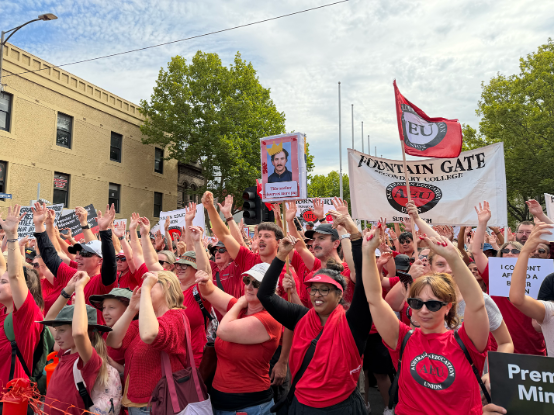
More than 30,000 Victorian teachers and education staff have gone on strike for the first time in over 13 years in a bid for higher wages and better working conditions.
Highlighting excessive workloads, unpaid labour and a cost of living that continually outpaces wages, protesters congregated at Trades Hall and proceeded to walk to state parliament, chanting and cheering.
The rally was led by President of the Australian Education Union (AEU) Victorian branch, Justin Mullaly. He said the strike was inevitable.
“We’ve got a shortage of teachers... we’ve got a shortage because there’s poor rates of pay,” he said. “All we want is a fair deal.”
The union has rejected the government’s offer of a 17 per cent pay increase over the next four years, asking for a 35 per cent increase over the same period.
Victorian Premier Jacinta Allen earlier in the week disparaged the strike, citing strain on parenting as students are forced to stay home.
“It’s unfortunate that parents cop the brunt of that, in some situations, but that’s on the government,” Mullaly said.
He said the strike is about more than just fair pay for Victorian educators.
“They want to be respected.”
Profile
by Steven Christou
3/3/26
I think [Amazon] owes me about 51 dollars.’Meet the writer running from Pokemon fan fiction to full-blown sci-fi epics.
I greet Callum on the first day of his graduate diploma. He sits before a thoroughly abused laptop. He talks swiftly, occasionally pausing to ensure I’ve really heard what he’s just said and taken the time to write it down.
Immediately Callum wants to get his origin story out of the way. With haste and a light-hearted embarrassment that lets me know it’s okay to laugh he touches on his brief career as a Pokemon fan fiction writer on the Amazon-owned Goodreads. He wishes that his origins had a little more moxie, though he finds the silver lining we’re all familiar with: the work wasn’t for free. (It should be noted that as of now he is yet to be paid in full by Amazon for his work as a Pokemon fan fiction writer.)
Two years later Callum’s story would begin to take shape. ‘I think covid ruined me,’ he says. Despite never contracting the illness, the mental residue of the Melbourne lockdowns of 2020 and 2021, his year 11 and 12 respectively, remain. I’m struck by a sudden change in his character as he recounts those years. His eyes drop and he speaks slowly.
The pandemic’s effects for Callum were anything but abstract: his grades slipped, he failed multiple classes, and he became miserable. But he ‘somehow managed to squeeze out a decent English exam.’ This, he explains, is why he’s able to be here — at university — at all.
Before covid struck, Callum’s keen interest in astronomy led him to dream of being an astrophysicist. His mother regularly took him to free astronomy lectures at Swinburne University, nourishing his love of exoplanet studies, the study of planets orbiting the sun.
When the pandemic was in full force, Callum found solace in the pages of George RR Martins A Song of Ice and Fire, books Callum credits with ‘saving [his] life’, developing his taste for fantasy, and lowering his grades.
Combining his love for astronomy, his literary interests and his unease, he would begin work on an original science fiction series, Arm of Orion. These novels have since been abandoned, and that’s okay with Callum, as he has much loftier ambitions.
He casually tells me that his next project, a 120-thousand-word sci-fi epic, is imminent. ‘It will be done next week.’ His conviction is palpable.
Towards the end of our chat, Callum switches gears. He digresses into what I can only describe as his educating me on why my personal notions of good and evil, right and wrong are naive, borderline childish — all while invoking the 2010 animated comedy, Megamind.
Drawing parallels between the film’s fictional lead and the very real President of the United States, Callum outlines what he calls ‘villainy as theatre’, essentially a performance of evil unique to this point in history. This theatre hides something ‘much worse underneath’, he explains. Where does this leave Callum? And where does this leave the rest us? Callum doesn’t know, nor does he think it’s his job to know. ‘Megamind is brilliant. The best superhero movie of all time.’
Our conversation trails off, we’re both exhausted. I ask Callum if he’s thought about getting the money he’s owed off Amazon. ‘They keep emailing me.’
20/05/26
by Steven Christou
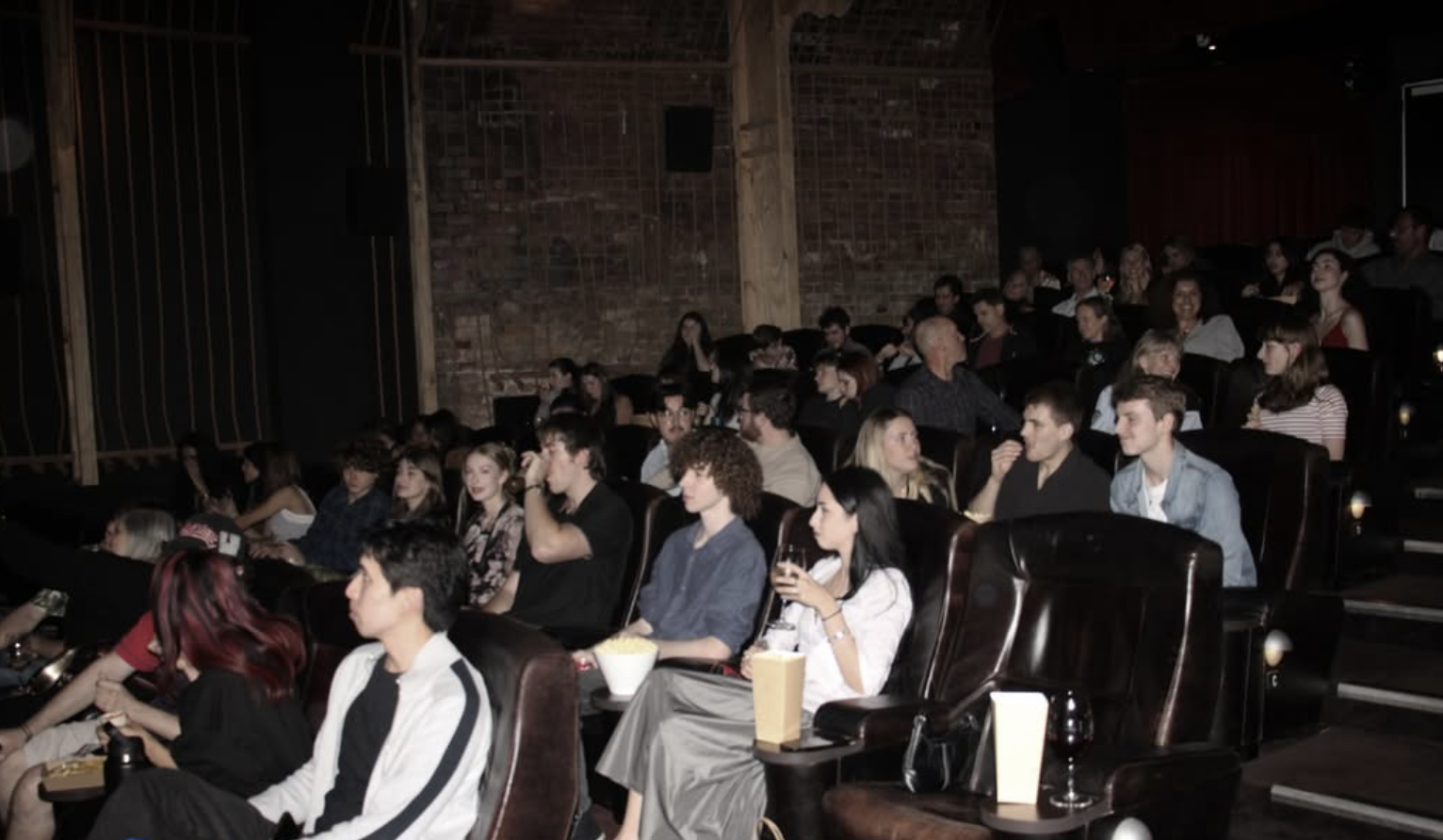
Independent post-apocalyptic film Omega One screened at the Classic Cinemas in Elsternwick on March 20th.
The project is a rarity – an Australian film with an all-female roster of writers and directors.
Only 16% of Australian films are directed by women. The film represents a push by female filmmakers towards independent films as they sidestep studio governance.
“Women are often rejected from the bigger productions, hence we all navigate to the independent films,” says Jessica Henderson, co-writer and star of Omega One.
The screening played to cinema at capacity with seventy-four seats sold.
Written and directed by three female filmmakers, the picture is part of a growing trend in independent cinema, as women continue to flood to smaller productions to take on scarce creative work.
Exact numbers are difficult to determine, but independent films appear to attract more women crew members than larger commercial productions.
Elmarie De Beer, co-director, co-writer and star of Omega One, speaks of this phenomenon.
“It feels like women need to climb three mountains for the same visibility as a man… probably why independent film productions give more space to women,” she says.
Her collaborator, Henderson, says independent cinema grants women the freedom to create on their own terms.
“We discovered if we don't just get out there and do it ourselves, these guys would never give us the opportunity,” Henderson says.
But the freedom these Australian filmmakers seek in independent filmmaking comes at its own cost as local films struggle to compete with foreign projects.
Despite an unstable film production ecosystem, there is a desire from local filmmakers to create. In Australia last year, thirty-one independent films that premiered were local, while only thirteen were international.
The Australian Government’s legislative attempts to push major streaming platforms to invest in local content are too recent to observe any tangible impacts.
Co-director, co-writer and actor Becca Rowe spoke of the precarious situation independent Australian films find themselves in.
“I think filmmakers want to have the safety of knowing that their film will have somewhere to go that isn’t just an oversaturated space like YouTube.” Though she is still optimistic. “Independent filmmaking means courage to me.”
De Beer offered her own potential solutions to the issue.
“I think the main thing I would say is making funding more widely available through grant systems, and also providing more education around the logistical side of it.”
Most film opportunities in Australia are freelance jobs at the behest of major studios, and the Omega One creatives represent a defiant sect of young artists making their own work.
Rowe explains the allure of this path. “It's ungrounded, risky, and very difficult. I think it’s about taking a massive leap in a direction that doesn't exist yet.”
De Beer concurs, saying, “Oftentimes, indie films are able to explore things in a way that A-list films don't because they're not as heavily bound by corporate decision-making.”
To De Beer the value of independent filmmaking is too great. “Independent filmmaking means the ability to tell and experience stories without censorship.”
Omega One will continue its release as the project’s filmmakers hope for a distributor to adopt the project.
Independent Melbourne film Omega One with all-female writers and directors screens at Classic Cinemas